September 10, 2026
Choosing a Handheld Batch Coding Printer for MRP & Expiry Printing
MRP, batch and expiry marking is mandatory on most packs sold in India. A beginner guide to choosing the handheld inkjet printer that puts it on your packaging.
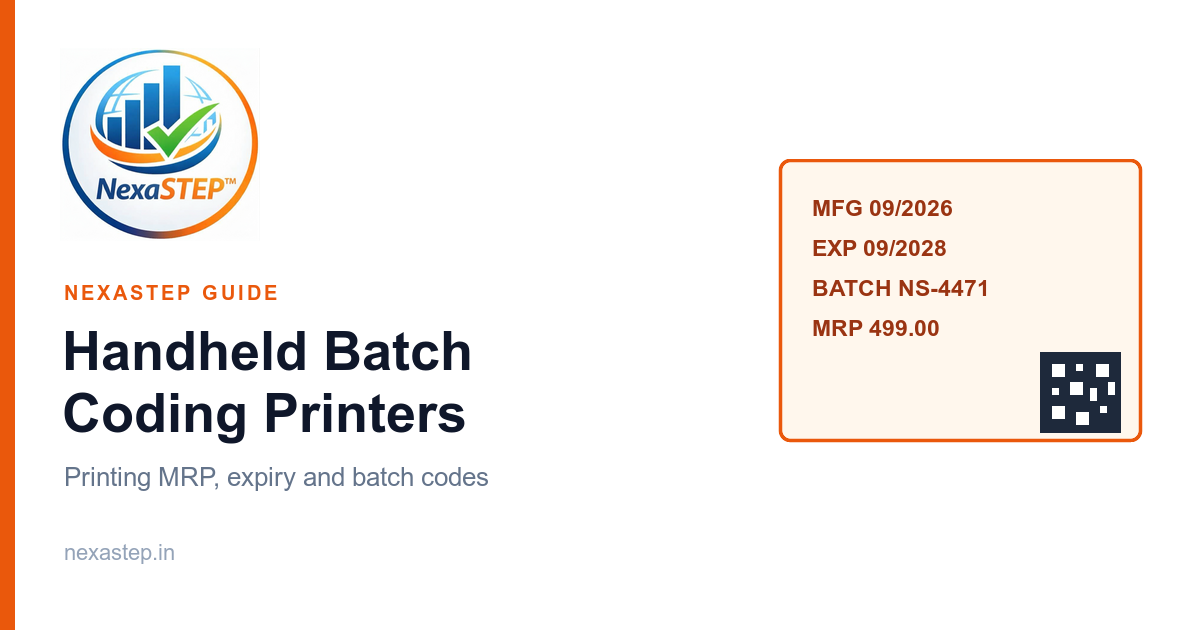
If you pack and sell a physical product in India, the manufacturing date, the expiry or best-before date, the batch number and the MRP are, for almost every product category, a legal requirement rather than a nice-to-have. The question is not whether to print them but what to print them with.
For most small and mid-size manufacturers, the answer is a handheld inkjet printer marking the carton or pouch directly on the packing line. This guide explains what these machines are, how to compare them, and where buyers most often lose money.
⚡ Short answer
Compare on ink cost per thousand prints, not machine price — a locked cartridge will cost you more in a year than the machine saved. Then check print width against your longest line, battery life against your real daily count, that the ink suits your surface, and whether it does variable data if you need a unique code per pack.
On this page
What has to appear on the pack
Under the Legal Metrology Packaged Commodities Rules, a packaged commodity sold in India carries a declared maximum retail price and a batch or lot identifier, and for perishable categories the manufacturing date and an expiry or best-before date as well. The exact set depends on your product category, so confirm what applies to yours — but in practice most packers are printing the same four things.
Figure 1 — A typical code block on a carton
The text is the legal requirement. The scannable code is optional, and is what makes an individual pack traceable rather than just compliant.
What a handheld inkjet printer is
A handheld thermal inkjet, or TIJ, printer is a battery-powered device about the size of a large stapler. You compose a message on its screen, then either swipe it across the pack or hold it steady while the pack moves past. A guide roller measures travel so the print does not stretch or compress. Ink dries in about a second, and there is no label, no ribbon and no conveyor to integrate.
Figure 2 — The parts of a handheld TIJ printer
The cartridge holds both the ink and the nozzles, so every cartridge change also replaces the print head. That is why cartridge choice dominates running cost.
Four things to check before you buy
📏 Print width
Must cover your longest line at a legible size. Common heads run from about 12.7 mm to 25.4 mm (half an inch to a full inch); taller blocks need a wider head or a second pass, which doubles handling time.
🔋 Battery life
Judge it against your real daily print count, not the datasheet best case. A shift that outlasts the battery means a second battery, not a compromise.
💰 Ink cost per 1,000
Cartridge price divided by yield. This single number decides your cost of ownership, and it is the one sellers are least keen to put in writing.
🔑 Variable data
Needed only if every pack must carry a different code. A fixed-message-only machine cannot be upgraded into one later, so decide before buying.
Cost-per-print formula
Cost per print = Cartridge price ÷ Prints per cartridge
Run this before you compare machine prices. A dearer machine taking widely available standard cartridges routinely beats a cheap one on a locked cartridge within the first few months.
Will it print on my packaging?
This depends on the ink rather than the machine, and it is the question most likely to be skipped in a sales conversation. Porous surfaces absorb water-based ink and hold it. Non-porous surfaces do not, so the ink sits on the surface and smudges unless you use a solvent or fast-dry formulation.
| Packaging surface | Type | Ink you need |
|---|---|---|
| Corrugated carton, kraft | Porous | Standard water-based |
| Uncoated paper labels | Porous | Standard water-based |
| Plastic film, pouches | Non-porous | Solvent or fast-dry |
| Foil laminate | Non-porous | Solvent or fast-dry |
| Glass, metal, coated board | Non-porous | Solvent, and test first |
⚠️ Always ask for a sample print on your own packaging
Not on the seller's demo carton. Send them your actual pouch, carton or bottle and ask for a printed sample back. Then smudge it with a thumb after ten seconds. This single test catches the ink mismatch that otherwise surfaces on your first production run.
Fixed message or a unique code on every pack
A basic handheld printer repeats one fixed message on every pack. For MFG, EXP, BATCH and MRP that is usually correct, because those four values are identical across a production run and only change between runs.
Item-level traceability is a different requirement. If you want each individual unit to carry its own verifiable code — so a specific pack can be traced, or a customer can check that the one in their hand is genuine — the printer has to support variable or graphic data, pulling a different value for each print from a list. That is a distinct hardware and firmware capability, not a setting you can enable later, so confirm it up front if it matters to you. Our design tool covers the equivalent for printed labels.
Your first print, in five steps
Charge it fully and fit the cartridge. Peel the protective tape off the nozzle plate before inserting, and do not touch the nozzles with a finger.
Build your message on screen. Enter the fixed text, then add the date fields as auto-updating variables rather than typed text so the expiry advances by itself.
Set height and print delay. Height fits the text to your head width; delay decides how far in from the pack edge the print starts.
Test on a spare pack. Keep the roller flat against the surface and move at a steady speed. Wobble and speed changes are what stretch or squash a print.
Smudge-test after ten seconds. If it smears, your ink does not suit the surface. Fix that now, before you code a full batch.
Four traps to avoid
1. The locked cartridge
The machine is cheap because it only accepts the seller's own chipped cartridges at a large markup. Ask directly whether it takes standard cartridges, and what a replacement costs on the open market.
2. Buying on print width alone
A wider head is only useful if your message needs the height. Paying for width you will not use, while ignoring ink cost, is the most common way to overspend here.
3. Wrong ink for the surface
Water-based ink on a plastic pouch prints beautifully and wipes off with a thumb. Confirm porous or non-porous before ordering, and test on your own packaging.
4. Assuming it can do QR later
Variable and graphic data support is a capability the machine either has or does not. If item-level traceability is anywhere on your roadmap, buy for it now rather than replacing the unit in a year.
Quick glossary
- TIJ — thermal inkjet, the technology behind almost every handheld coder.
- Batch coding — marking a pack with the run it came from, plus dates and price.
- MRP — maximum retail price, a mandatory declaration on Indian packs.
- Porous / non-porous — whether the surface absorbs ink; decides which ink you need.
- Yield — how many prints a cartridge delivers; the denominator in cost per print.
- Variable data — printing a different value on each pack rather than one fixed message.
- Print delay — how far in from the leading edge the print begins.
Where to go next
If item-level traceability is what you are after, printing a unique QR code on every pack shows the whole job from a phone, one screen at a time. If you would rather apply a printed label than code the pack directly, start with the label material guide and then the ribbon guide, which together cover the label route end to end.
Tell us what you pack and how much
NexaSTEP builds its own handheld and industrial batch coding printers. Send us your packaging surface and daily volume and we will recommend a model — and print a sample on your own pack first.
Frequently asked questions
- Do I legally need to print MRP, batch number and expiry on my product?
- For most packaged goods sold in India, yes. The Legal Metrology Packaged Commodities Rules require the maximum retail price and the batch or lot number on the pack, and for perishables and several other categories the manufacturing and expiry or best-before date as well. Requirements vary by product category, so check what applies to yours, but for the great majority of packed food, FMCG and pharma products this marking is mandatory.
- What is a handheld inkjet printer, and why is it so common for this?
- It is a battery-powered, roughly pen-sized printer that sprays quick-drying ink directly onto a carton, pouch or bottle as an operator moves it across the surface. No label is involved. It is the usual choice for small and mid-size packers because it needs no conveyor integration, costs a fraction of a fixed in-line coder, and one unit can move between packing lines.
- What does TIJ mean?
- Thermal inkjet. It describes how the printer fires ink: a tiny heater in each nozzle boils a microscopic amount of ink, and the resulting bubble pushes a droplet onto the surface. Almost all handheld coders sold today are TIJ, and they use cartridge-based ink rather than a bulk reservoir, which is why cartridge cost matters so much.
- What should I actually check before buying one?
- Four things dominate. Print width, which must cover your longest text line at a legible size. Battery life measured against your real daily print count. Ink cost per thousand prints, which depends on cartridge price and yield rather than the machine price. And whether it supports variable data, if you need a different code on every pack rather than one repeated message.
- Can I print a unique QR code alongside the batch and expiry text?
- Only on printers that support variable or graphic data rather than a single fixed message. That capability is what lets every unit carry its own traceable code instead of every pack in a batch showing an identical print. Not every handheld printer in this price range supports it, so confirm before buying rather than after. On our own machines it is included rather than charged for as an upgrade.
- Will it print on plastic, foil and glass, or only cardboard?
- It depends on the ink, not the printer. Standard water-based ink is made for porous surfaces such as cartons, kraft paper and uncoated board. Non-porous surfaces like plastic film, foil laminate, glass and metal need a solvent or fast-dry ink instead. Using water-based ink on plastic gives a print that smudges with a fingertip, so tell your supplier the surface.
- How much does a handheld batch coding printer cost to run?
- Work it out as cartridge price divided by the number of prints a cartridge yields, not from the machine price. A cheaper machine locked to proprietary chipped cartridges usually costs far more over a year than a slightly dearer one that takes widely available standard cartridges. Ask for the yield and the open-market cartridge price in writing before you buy.
- Handheld or a fixed in-line printer?
- Handheld suits variable production, mixed pack sizes and volumes up to a few thousand packs a day, where an operator can code packs as they are packed. A fixed in-line coder mounted over a conveyor makes sense once volume is consistently high and the line runs continuously, because it removes the operator from the loop entirely.