September 12, 2026
Batch Coding Machine Price in India: What It Costs to Buy, and to Run
What a batch coding machine actually costs in India, and why the purchase price is the smaller half of the question. How to work out your real cost per thousand prints before you buy.
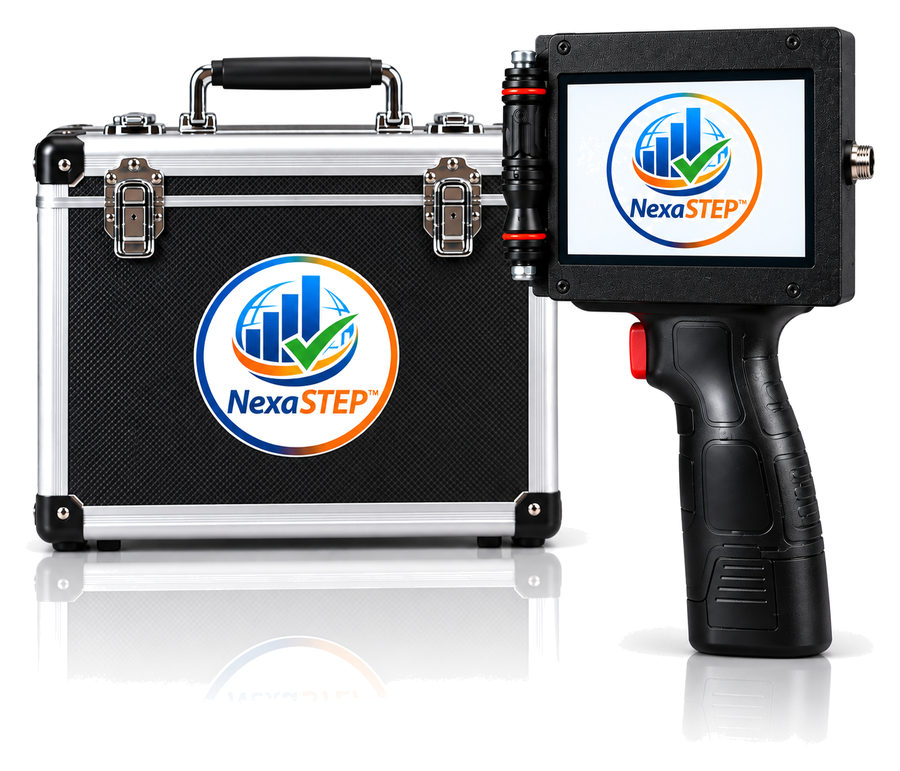
Ask what a batch coding machine costs and you will get a number between ₹9,000 and several lakh, which is not an answer. The spread is real, but it is a spread across completely different machines doing the job in completely different ways. And the purchase price, whichever one you land on, is the smaller half of what you will actually spend.
What this guide covers
What you are actually choosing between
Nearly every quotation you will receive is for one of three things, and they are not competitors so much as answers to different volumes.
| Kind | How it works | Suits |
|---|---|---|
| Handheld TIJ | Battery unit you draw across the pack. Ink and print head in one cartridge. | Up to a few thousand packs a day, several products, no fixed line |
| In-line TIJ or CIJ | Head mounted over a conveyor, triggered by a sensor as packs pass. | Continuous high-speed lines where the operator should be out of the loop |
| Laser coder | Burns the mark into the surface. No consumable ink at all. | High volume on suitable substrates, where permanence is the point |
If you are packing a few hundred to a few thousand units a day, across more than one product, without a conveyor already running, the handheld is the machine this question is really about. The rest of this guide is mostly about that case.
What each kind costs to buy
Broad bands, because the market moves and because specification varies enormously inside each one. Treat these as orientation, not as a quotation.
- Entry handheld TIJ — roughly ₹10,000 to ₹25,000. Prints the standard block of MRP, batch, dates and a code. This is where most first purchases land.
- Feature-rich handheld — upward of that again, sometimes several times. You are usually paying for taller print, a better screen, sturdier construction or faster throughput.
- In-line systems — several times a handheld at minimum, before mounting, sensors and installation, which are rarely in the headline figure.
Watch for prices behind an enquiry form
A listing that will not show a price until you submit your phone number is usually not withholding a bargain. Compare suppliers who publish what they charge, and note the date on any price you are quoted — figures in this category go stale fast.
The number that decides your real cost
The machine is paid for once. The cartridge is paid for every month, for as long as you run the machine. That makes cost per thousand prints, not purchase price, the figure that decides what coding actually costs your business.
On a thermal inkjet machine the print head is built into the cartridge. That is good news for reliability, because a blocked nozzle is a consumable rather than a service call, but it means the cartridge carries more of the cost than a bottle of ink would on another technology. It is the line item worth interrogating before you commit.
Working out your own cost per thousand
The arithmetic is deliberately simple, and any supplier should be willing to fill in the two inputs for your job in writing.
Cost per thousand prints
cartridge price ÷ cartridge yield × 1,000
Worked example: a cartridge at ₹2,400 that yields 60,000 prints of your message on your surface gives 2,400 ÷ 60,000 × 1,000 = ₹40 per thousand packs. At 3,000 packs a day that is about ₹2,600 a month in ink.
The trap is the yield figure. Yield varies with how tall you print, how many characters are in your message and what you print onto — a four-line block on absorbent kraft consumes far more than a short date code on coated board. A single headline yield number quoted without reference to your job is close to meaningless. Ask for an estimate against your actual message and your actual material.
Ask for both numbers in writing
The open-market cartridge price and the expected yield for your print. With those two you can compare any two machines honestly, whatever their purchase prices are.
Why a locked cartridge changes everything
Some coders accept standard TIJ cartridges from any brand. Others are chipped or region-locked so that only the manufacturer can supply them. The difference does not show up on the day you buy. It shows up every month afterwards, because a locked machine hands one supplier permanent control of your running cost with no competing price to check it against.
This is the single most common way a cheap machine turns out expensive. Before you pay, ask plainly whether standard cartridges fit, and whether you may buy them from anyone. A supplier confident in their pricing will not mind the question.
Four costs that are not on the quotation
- A second ink type. If you pack into both carton and plastic you need water-based and solvent-based cartridges. One machine, two consumables.
- Recoding a batch. Fit the wrong ink for the surface and the print never sets. That is scrap plus the labour of doing the batch again.
- Installation and downtime. Real on in-line systems, effectively zero on a handheld. It is the largest single reason the handheld wins at low volume.
- Training concentrated in one person. If only one operator can run it, the machine stops when they are on leave. Choose something that takes ten minutes to teach.
Where to go next
If you know the machine kind you need, our handheld batch coding machines are listed with live prices and stock, so you can see what one costs without asking. If you are still deciding which one fits your pack, start with choosing a handheld batch coding printer. For ink types and the running-cost arithmetic applied to a real cartridge, see ink, service and getting started.
Tell us your print, your surface and roughly how many packs a day, and we will give you a yield estimate and your real cost per thousand before you order. Talk to us.
Frequently asked questions
- How much does a batch coding machine cost in India?
- It depends on the kind of machine far more than on the brand. Handheld thermal inkjet coders are the entry point, typically somewhere between ₹10,000 and ₹25,000 for a basic unit, with feature-rich handhelds running considerably higher. Fixed in-line systems mounted over a conveyor start several times above that and climb into lakhs once installation is counted. Always check a live price rather than a listing page, because quoted prices in this market go stale quickly.
- What is the cheapest way to print MRP and expiry on my packs?
- For low and medium volumes, a handheld coder is almost always the cheapest route, because it costs nothing to install. There is no conveyor to buy, no mounting to engineer and no production stoppage while it is fitted. The machine is the whole capital cost. Pre-printing the dates onto stock is cheaper per unit but commits you to a date before you have made the product, so every change of plan becomes scrap.
- What is cost per thousand prints, and why does it matter more than the machine price?
- Cost per thousand is the cartridge price divided by the cartridge yield, multiplied by a thousand. It matters more than the machine price because you pay it every month for the life of the machine, while the machine is a one-off. A coder that saved you ₹15,000 on the day you bought it can quietly cost you more than that within a year if its cartridges are dearer or yield less.
- Why do some batch coding machines have much cheaper cartridges than others?
- Because some machines accept standard open-market cartridges and some are locked to the manufacturer. A chipped or region-locked cartridge means one supplier sets your running cost for the life of the machine, with no competing price to check it against. Before you buy, ask whether standard TIJ cartridges fit, and ask for the answer in writing.
- Is a cheaper batch coding machine a false economy?
- Not necessarily, but the purchase price tells you very little on its own. Ask three questions instead: what a cartridge costs on the open market, what it yields on your own print and your own surface, and whether the print head is inside the cartridge. On a thermal inkjet machine the head is a consumable, which is what stops a blocked nozzle from becoming a repair bill.
- What costs are not on the quotation?
- Four usually. Cartridges for more than one surface type if you pack in both carton and plastic. Downtime when the wrong ink is fitted and a batch has to be recoded. Shipping and installation on in-line systems. And the cost of a machine sitting idle because the only person trained on it is on leave, which is an argument for choosing something that takes ten minutes to learn.
- Does GST apply, and can I claim input credit?
- Yes. Coding equipment of this kind is invoiced with GST against HSN 8443 32 50, and a registered business can claim input tax credit on it in the normal way. You need a proper tax invoice raised against your GSTIN, which is worth confirming before you pay a supplier who is quoting you a cash price.
- Should I buy or rent a batch coding machine?
- At handheld prices renting rarely pays. The purchase price is low enough that a rental recovers it within months, and you are left with no asset and still paying for cartridges. Rental makes more sense at the in-line end, where capital cost is high and a short contract packing run may not justify owning the equipment.